- Dependency injection is a technique where application components don't create their dependencies on their own, but instead declare the dependencies' interfaces, and then the application context finds and applies real implementations of them
- Advantages:
- Reduced coupling
- Increased cohesion
- Reduced boilerplate code
- Facilitates testing (use of mocks in place of dependencies)
- Increased code maintainability, re-usability and readability
- Interface is a Java reference type that holds a blueprint of the functionalities that should be implemented from a class. It provides a contract for an object's functionalities. It enforces the implementation of an API.
- Advantages:
- Decoupling of contract and implementation
- Enables implementations' interchangeability
- Allows implementation hiding, so that only the interface is public, and all implementations are protected, and thus one can only use e.g. @Qualifier("bean1") in caller class
- In Spring, allows the use of JDK Dynamic Proxy
- ApplicationContext is the representation of the Spring IoC container, and holds registered and initialized beans and components, ready for use in runtime. Also:
- Provides access to the Environment abstraction and its properties
- Pushes events to registered listeners
- Manages beans lifecycle
- Resolves internationalization messages
- Web applications:
- Inside a class implementing ServletContainerInitializer, use AnnotationConfigWebApplicationContext to include a Java Configuration file
- Use a WebXmlApplicationContext, to include xml(s) holding all configuration
- Standalone application:
- Use AnnotationConfigApplicationContext to include a Java Configuration file
- Use ClassXmlApplicationContext to load the xml configuration from classpath/jar
- Use FileSystemXmlApplicationContext to load the xml configuration from the file system
- Container is an execution environment that plays a central role in assembling user-defined components, managing their lifecycle and also providing basic functionalities, like HTTP and REST.
It usually supports the inversion-of-control (IOC) principle, so that the programmer only creates beans and declares dependencies, and finally the Container does the underlying work of linking all together. - Lifecycle:
- App starts
- Container is created and load all configuration to
- create Bean Definitions
- Any BeanFactoryPostProcessors now run to alter the definitions
- Bean instances are created
- Any bean dependencies and property injections are resolved
- Any BeanPostProcessors run to alter bean instances
- App now is up and ready
- App shutdown is initiated
- Context is closing
- Any destruction callbacks take place to release resources, etc
- Context is created
- Bean Definitions created (Spring Bean Configuration)
- BeanFactoryPostProcessors
- Bean Instance created (constructor runs)
- Properties and dependencies are resolved
- BeanPostProcessor: postprocessBeforeInitialization method
- @PostConstruct annotated method
- InitializingBean::afterPropertiesSet
- @Bean(initMethod)
- BeanPostProcessor: postprocessAfterInitialization method
- Bean ready to use.
- Bean destroyed:
- @PreDestroy
- DisposableBean::destroy
- Bean(@DestroyMethod)
- Import maven dependencies of spring-test and JUnit
- Before JUnit 5: Annotate test class with @RunWith(SpringRunner.class) and @ContextConfiguration(classes = MyAppConf.class)
- After JUnit 5: Annotate test class with @ExtendWith(SpringExtension.class) @ContextConfiguration(classes=MyAppConf.class)
- If @ContextConfiguration has no "classes" attribute, then xml <TestClass>-context.xml will be loaded
- @ContextConfiguration can also accept XML config:
- Example: @ContextConfiguration("file:src/main/webapp/WEB-INF/spring-config.xml")
- To above, add annotation @WebAppConfiguration to load a web related test context. However on Spring Boot, @SpringBootTest already provides a WebApplicationContext.
- Use @DirtiesContext to clean/restart context between tests
- Non-web / Standalone app: Call registerShutDownHook immediately on a AnnotationConfigApplicationContext. This will trigger a JVM shutdown informing all beans, etc
- Don't use close() on the context, since some exception may occur before that
- Web app: Servlet will send closing event to ContextLoaderListener, which in turn will close the application context
- Spring Boot: Automatically registers the shutdown hook which closes the application context. For web apps, the same logic with above ContextLoaderListener applies
- By default, Beans (Singletons by default) are eagerly instantiated on startup.
- Note that each singleton bean is used for multiple threads.
- Beans with prototype scope are lazily instantiated (on demand)
- To alter, below ways exist:
- @ComponentScan(lazyInit = true) to make scanned beans lazy
- @Lazy on Bean to change default eagerness to lazy
- @Lazy(false) to force eagerness
- @Lazy on @Component class
- @Lazy on @Configuration class (makes all @Bean-s lazy)
Property sources are key-value pairs in yaml/xml files, and accessed using a Spring abstraction on Environment key-value pairs (JVM, JNDI, system ..)
@PropertySource is used on top of a component class, like:
@PropertySources({
        @PropertySource("file:${app-home}/app-db.properties"),
        @PropertySource("classpath:/app-defaults.properties")
})- If using non-default properties file name (other than application.properties/yml), define a PropertySourcePlaceholderConfigurer bean with the @Bean annotation to activate the placeholder resolving mechanism
- Set @Value("${propertyKey:defaultValue}") on a field, to retrieve and initialize it
Dependency injection using Java configuration?
Component Scanning, stereotypes?
- Dependency injection using Java configuration

- SpringBean1,2,3 are plain POJO classes
- In our central configuration class, we appoint them as @Bean-s
- Use of @Autowired to inject SpringBean1's dependencies (SpringBean2,3)
- Dependency injection using Annotations (@Component, @Autowired)
- Each bean will be annotated with @Component in its own class file
- If any bean has dependencies on other beans, we create fields of these beans annotated with @Autowired
- The Configuration file is annotated with @ComponentScan, and placed on a directory level higher than all our @Component beans


- Component Scanning, Stereotypes?
- Spring will scan project classpath for classes annotated with stereotype annotations like @Component, @Repository, @Service, @Controller and more, in order to create Bean Definitions.
- @ComponentScan is used for this, applied in project root usually
- Attributes "basePackages", "includeFilters", "excludeFilters" can be added for named adjustments.
- Stereotypes refer to annotations that define some specific role in the project, thus:
- @Component (Spring component, scanning candidate)
- @Controller (Component to handle the web layer)
- @Service (Component to handle the Service layer)
- @Repository (Component to create beans in DAO layer)
- Scopes for Spring beans? What is the default scope?
Scopes: Singleton, Prototype, Request, Session, Application, WebSocket
Default scope for @Components is the Singleton scope (also eager)
Singleton: Never hold state in these, in a multithreaded environment. All threads access the unique shared instance, and there may be concurrency issues. More:
https://dzone.com/articles/how-does-singleton-bean-serve-multiple-requests-atPrototype: A typical use case to create a bean in request scope is for information that should only be valid on one page. For example, the confirmation of an order. The bean will be valid until the page is reloaded.
Prototype case: A Singleton bean might contain a prototype bean. The issue is that since the Singleton will be instatiated only once, the prototype bean instance will be also unique. To solve this issue use the Lookup Method Injection: https://docs.spring.io/spring-framework/docs/3.0.0.M4/reference/html/ch03s04.html#beans-factory-lookup-method-injection
- BeanFactoryPostProcessor is an interface holding one postProcessBeanFactory method
- It is used to modify(not create) Spring Bean metadata, that will be used later to create the actual Beans
- It is invoked before Spring Bean is created and after Spring discovers all Bean Definitions
- BeanPostProcessor holds two methods: postProcessBeforeInitialization and postProcessAfterInitialization
- The difference with BeanFactoryPostProcessor, is that it acts after the Spring Bean is created from the Bean definition, and its dependencies and property injections are done
- Thus BeanFactoryPostProcessor acts on Bean Definition, while BeanPostProcessor acts on actual Spring Bean object
- The reason would be to have it run before any object instance creation is done
- Example:

What is a PropertySourcesPlaceholderConfigurer used for?
- Ιt is a BeanFactoryPostProcessor bean used to resolve properties' placeholders in Spring Beans, and specifically on fields with @Value("${propertyName}") annotation
- Initialization method purpose is to perform alterations on Spring Bean after all properties and dependencies are resolved. Otherwise, having initialization functionality inside constructor is a bad practice, since properties and dependencies may not have been resolved yet
- Three ways to set init method:
- @Bean(initMethod = "initMyBean")

- @PostConstruct

- Implement InitializingBean and override afterPropertiesSet (not recommended)
What is a destroy method, how is it declared and when is it called?
- Destroy method is called to release resources a Bean uses, before it reaches end of life
- It is declared in three ways:
- @PreDestroy annotated methods inside Beans
- Implementing a DisposableBean in our Bean class, and overriding its destroy() method
- Use @Bean(destroyMethod = "someDestroyMethod")
- Singleton beans (as default @Component-s) destroy method is called when application and Spring container starts to shut down. A session-scoped bean's destroy will be invoked after session ends. Same for request-scope. But, prototype-scoped beans aren't tracked from Spring after being created, so destroy method won't be called automatically.
When using AnnotationConfigApplicationContext, support for @PostConstruct and @PreDestroy is added automatically. Specifically, these are handled by CommonAnnotationBeanPostProcessor.
- Spring framework scans project classpath in search for classes annotated with Stereotype annotations (@Component, @Controller, @Service, @Repository), and creates Bean Definitions in Spring container.
Autowired annotation is processed by AutowiredAnnotationBeanPostProcessor and enables automatic Spring Dependency Resolution based on types. If there are multiple implementations for a type, we need to specify the unique candidate, usually with @Qualifier or @Primary or Spring will automatically match bean name
Autowired injection takes place after Bean constructor is run, to resolve the wanted dependencies. Autowired injections finishes before any initialization method (@PostConstruct, InitializingBean, @Bean(initMethod))
Constructor injection: @Autowired is applied above constructor method. All dependencies must not be null. If we expect some dependency to be null, use Optional, @Nullable, or @Autowired(required=false) for that parameter. If we have many constructors, we must apply @Autowire in one only.
Tip: Use constructor injection to ensure with IoC container that all required dependencies are successfully initialized, and prevent NPEs. Additionally, all dependencies are visible in one place, and any refactoring need is facilitated.Method/Setter injection: Same as above, and also if some parameter(s) are expected to be null, use @Autowired(required=false) above method. Preferable for optional dependencies.
Method injection - Map/Collection:
@Autowired
public void setRecordsReaders(List<RecordsReader> recordsReaders) {}Spring autowires all implementations of interface RecordsReader, by @Order or @Priority annotations, or Ordered interface
Field injection: Same as above
More: https://reflectoring.io/constructor-injection/
- Use @MockBean to inject a mock in a private field (Here, ReportWriter is a private field of ReportService). Spring Test framework will create an application context, where the ReportWriter Bean will be replaced with a mock.

- Use Mockito mock. No Spring application context is loaded here, only plain mocks. @InjectMocks will recognize and inject @Mocks that are dependencies of ReportService

- Use ReflectionTestUtils to alter a private field using Reflection. Not recommended since a name refactoring will break this

- Use @TestPropertySource to introduce a test properties file, to be utilized by @Value annotations in the code.

Here, the targeted private field is a String. The @Value annotation will read property from the test property file of @TestPropertySource
- "dbRecordsProcessor" will be matched with available Bean name


- Or define explicitly in @Component attribute the Bean name to match

- Or define explicitly using @Qualifier

- Include @Qualifier inside a custom meta-annotation
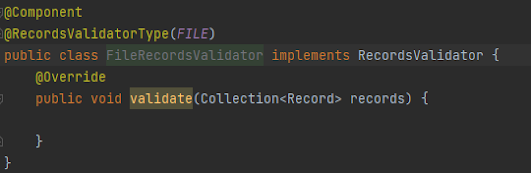

- Use @Qualifier inside method parameters :
@Autowired
public void doStuff(@Qualifier("book") Book book)
- Proxies are used to add additional functionality on top of a class by intercepting caller access to this class, without altering class code. Proxies help on applying separation of concerns, e.g. logging, security, etc. Proxies hold same public method as the proxied class, to provide known access points
- Example in Spring: There is a CGLIB proxy for each @Component singleton bean, to ensure all callers use the same and unique instance.
- Disadvantages:
- Code hard to debug
- Proxies not serializable
- JDK Dynamic proxy
- Proxied must implement an interface
- Only interface methods can be proxied
- No support for self invocation
- CGLIB proxy
- Proxied does not have to implement an interface
- Proxied must not be final (CGLIB needs to extend this)
- Advantages of Java Config versus XML configuration:
- Compile-time checking vs XML's runtime checking
- Most IDEs support refactoring adjustments for Java Config, while not for XML config
- Advantages of Java Config versus Annotation-based configuration:
- Beans are organized in single @Configuration file (better project organization)
- Separation of concerns (Beans implementation resides outside the @Configuration + @Beans file)
- Tech-agnosticism (Beans' implementations is a POJO class, not glued to Spring framework, while e.g. @Component class is Spring-specific)
- Ability to integrate with 3rd-party libraries (Just have a @Bean method returning some modified library instance)
- Disadvantages of Java Config:
- @Configuration file and @Beans must not be Final, because these annotations utilize a CGLIB proxy which demands proxied object to be inheritable.
Note: CGLIB proxying is used to ensure that all callers access a single instance of the Bean (@Bean is by default a Singleton)
What is the default bean id if you only use @Bean? How can you override this?
- @Bean is used in @Configuration files to tell Spring container to manage it as a Spring Bean. It also can define a Bean name identifier.
- Cases of usage:
- By default, the method name ("springBean3A") is set as bean's name. If @Bean name attribute exists, then "springBean3rd" is set as name.

- Bean attributes "initMethod" and "destroyMethod"

- Bean attribute "autowireCandidate" to tell if this bean should be used as dependency to other beans
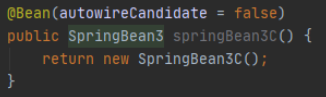
- @Configuration file and @Beans must not be Final, because these annotations utilize a CGLIB proxy which demands proxied object to be inheritable.
- Note: CGLIB proxying is used to ensure that all callers access a single instance of the Bean (@Bean is by default a Singleton)
Can you use @Bean together with @Profile? Can you use @Component together with @Profile?
- @Profile with @Component

- @Profile with @Configuration
(Also, we can have multiple configuration files per profile.
Then, import all / some config files in main Configuration file : @Configuration @Import({Config1.class, Config2.class , ...}))
- @Profile with @Bean (in @Configuration file)

- @Profile included in custom annotation


- Use ConfigurableEnvironment to set active profiles in Runner class

- VM options: Dspring.profiles.active="profile1,profile2,profile3"
- Use @ActiveProfiles in test class, to define profile(s) for Test Context to load

- In Spring Boot, use SpringApplicationBuilder to set profiles:

- In application.properties, define spring.profiles.active
- setActiveProfiles() accepts varargs, and that being a String array, can hold the maximum value of Integer (Integer.MAX_VALUE)
- Using @Value on field to inject value from properties file, in conjunction with @PropertySource


- Using plain primitive types

- Using spEL language (Below example also uses property reference)

- Can inject values from other Bean:

- Can inject values from VM options or environment properties with "$"
- Can inject whole Map, Sets in field

SpEL is an expression language that evaluates the given expression at runtime and the results are injected in a field ready to use
It can be used with:
- ExpressionParser and EvaluationContext
- On top of constructors, fields, method parameters using @Value
- SpEL expressions by default are interpreted dynamically at runtime, but we can choose to evaluate them in compile-time for performance reasons:
- SpelCompilerMode has values Off (no compiler-time evaluation), Immediate (compiler enabled after first interpretation) and Mixed (in case of evaluation exception switches back to runtime, and again to compiler later)
- Part of Spring Container that handles Profiles and Properties
- Can use directly Environment to fetch properties
- Decided default-activated profile, and active profile set by developer
- Provides standard ways to resolve properties from configured property sources (property files, JVM, system environment variables, JNDI, servlet config, context params)
- Standalone application: StandardEnvironment
- Web application: StandardServletEnvironment (has also servlet configs and context params)
- Common sources for Spring Standalone, Spring Web, and Spring Boot apps
- JVM properties
- Properties files
- Enviroment variables
- Sources for Spring Web app:
- JNDI
- ServletConfig init params
- ServletContext init params
- Sources for Spring Boot app:
- @TestPropertySource, @PropertySource
- @SpringBootTest's property attribute
- Command line arguments
- application.properties file (inside or outside or JAR)


- $ => reference a property in Spring Environment Abstraction
- # => spEL expressions parsed and evalueated by SpEL
